Having a car park that meets the highest standards is more than just drawing lines and creating bays. There are strict procedures you need to follow to create a safe space for everybody, which is why your car park line markings are crucial.
The right strategy takes what could be just an empty space with lines into a fully fledged, compliant car park that’s maxed out with efficiency.
In this blog, we’ll cover what steps you need to take, what rules you need to follow, and how professional thermoplastic line markings are essential for an efficient car park.
How to strategically lay out your car park
Here’s how you first max out the car park’s efficiency.
Ideally, you want as many parking spaces as possible while remaining safe, accessible, and legally compliant. So how do you lay out a car park that ticks all three boxes?
Angled parking vs 90-degree parking
Choosing how you angle your parking bays actually makes a bigger difference than you might think.
You really have two options: angled or 90-degree parking bays.
Angled parking bays typically have a 45-degree angle and are designed for one-way traffic. They’re much easier to enter and exit because the smaller turning radius requires less manoeuvring, which in turn helps the parking bay move more quickly and improves visibility for drivers pulling out.
90-degree parking bays are set straight against the driving lane, supporting two-way traffic flow. The benefit is that it allows access from either direction, but it requires wider aisles and trickier turns than angled parking, which increases the probability of minor collisions.
Although angled parking is less common in the UK, it’s the superior choice, as your parking bay is likely to run much more smoothly without issues.
Specific parking bays
Efficiency also means accessibility.
For a car park to be well designed, it needs to make it easy for every visitor to park safely, not just a certain few.
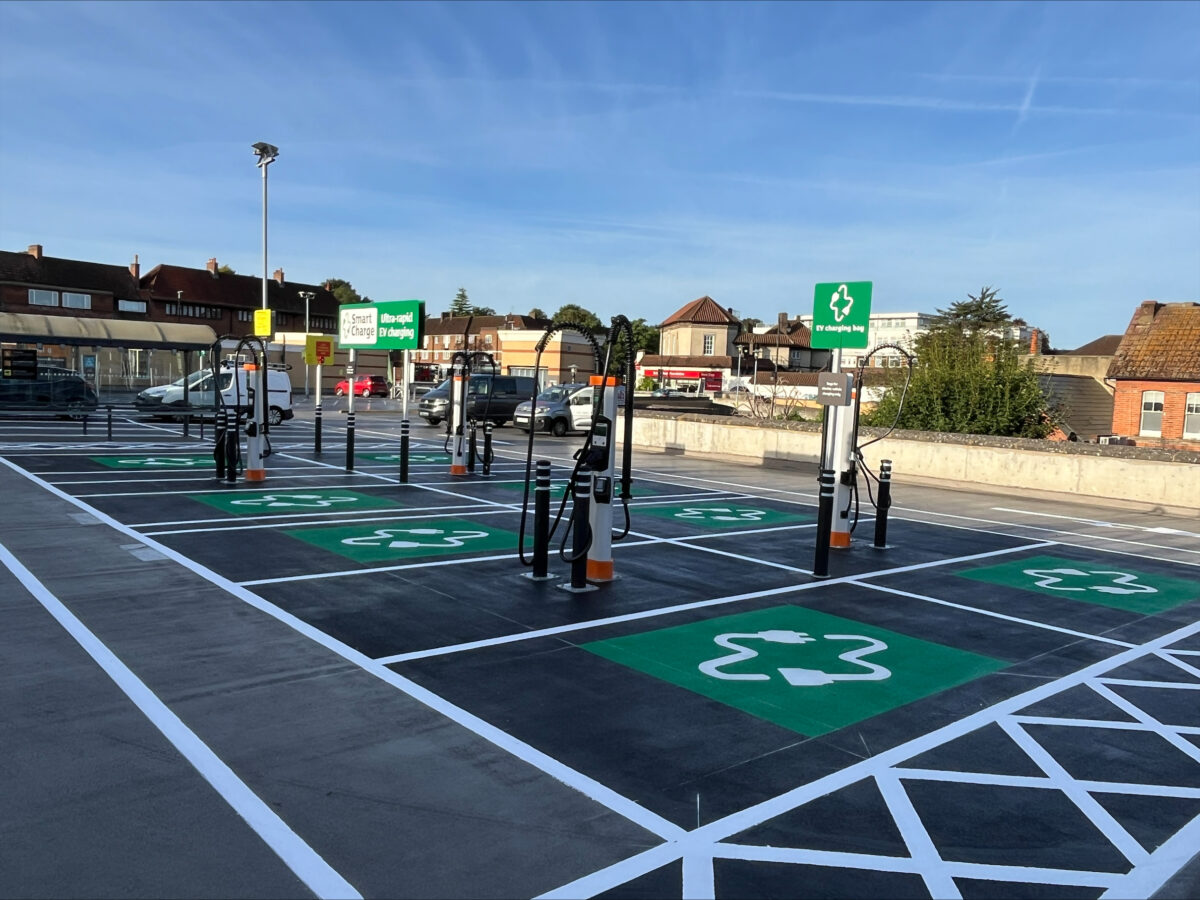
Clearly marked EV charging bays, disabled parking bays close to entrances and exits, and parent-child bays with safe pedestrian markings around them are crucial to making your car park as efficient as possible.
These bays have specific requirements that you must adhere to for legal and regulatory reasons.
Knowing these requirements and complying with them prevents issues with legislation, improves traffic flow in your car park, and ultimately enhances the user experience.
Read more: Disabled parking bays: rules and dimensions
How can you enhance traffic flow with safety
A car park designed for efficiency requires firm control of traffic and careful operation to run as smoothly as possible. When drivers know exactly where they are going, the risk of accidents and congestion plummets.
Directional markings and signage
To make your car park as clear as possible for everyone, use high-visibility arrows that mark exactly where the entry and exit points are.
It sounds incredibly simple, but doing this reduces the likelihood of those close encounters in tight areas where drivers become frustrated.
Prioritising pedestrian safety
The safety of pedestrians using your car park is of the utmost importance, so you need to ensure dedicated walkways are in place.
Using bright yellow or white markings creates a clear physical boundary between pedestrians and moving vehicles.
Why durability and regular maintenance are so important
The most brilliant layout is useless if it fades away within six months. Quality materials and regular maintenance keep a car park functional year-round.
The power of high-quality materials
Using standard paint will do your car park no favours, as it’s going to fail under heavy friction.
That’s why you need to use thermoplastic materials, as they’ll provide a reflective, hard-wearing finish that withstands heavy traffic and harsh weather, making them much more visible at night.
Scheduling regular inspections
Faded lines lead to “creative parking,” where drivers straddle bays and waste space.
Regular repainting and maintenance ensure your facility remains compliant with British standards and continues to operate at peak capacity.
Read more: Seasonal maintenance: looking after your car park
A final thought
Maximising car park efficiency is an investment in your property’s safety and reputation. By choosing a strategic layout, prioritising pedestrian zones, and using high-grade thermoplastic, you ensure a seamless experience for every visitor.
Ready to refresh your space? Ensuring your markings are crisp, compliant, and clever is the first step toward a more efficient facility.
Read more: How long do car park markings last?