

Anti-Skid Surfacing
High-performance anti-skid surfacing for car parks, pedestrian areas, loading bays, and commercial sites. We install cold-applied, BBA-approved systems that reduce slip risk, improve safety, and last.
Call our team
Specialists in anti-skid road surfacing
We install cold-applied anti-skid surfacing using epoxy and MMA (methyl methacrylate) resin systems bonded with calcined bauxite aggregate. It’s the same high-friction surfacing technology used on the UK’s most demanding roads, applied to the commercial and public sites where your staff, visitors, and vehicles need reliable grip.
The finished surface is thin (3-6 mm), tough, and built to handle years of heavy use. Cold-applied systems typically last 8-12 years with minimal maintenance, and well-prepared sites regularly exceed that.
All materials comply with Clause 924 (Skid Resistant Surfacing) and hold BBA Type 1 approval.
Who’s it for?
Almost everyone – Anti-skid surfacing helps reduce the risk of accidents, especially in high risk & heavy footfall areas. This can often be specified by facilities managers, property managers, local authorities, housing associations, NHS trusts, retail parks, schools, and logistics operators.
If you manage a site where people and vehicles share space, or where wet and cold conditions create a slip risk, this is the treatment that solves it properly.
Enquire now

Why cold-applied?
There are two types of anti-skid surfacing: cold-applied and hot-applied. We focus on cold-applied systems because they’re the better fit for the sites we work on.
Longer life. Cold-applied systems last 8-2 years on average, compared to 4-8 years for hot-applied. Some installations are still performing well after 18-20 years.
Better suited to commercial sites. Cold-applied epoxy and MMA systems are designed for car parks, pedestrian zones, and mixed-use areas. Hot-applied thermoplastic is primarily specified for high-speed highway networks where rapid curing (10-15 minutes) matters more than longevity.
No heavy heating equipment on your site. Cold application uses liquid resin spread at ambient temperature. There’s no specialist heating pot, no temperature-critical material handling, and less risk during installation.
Smoother finish. Cold-applied surfaces offer a more consistent finish, which matters on pedestrian walkways and car park decks where appearance matters as much as safety.

How it works
Cold-applied anti-skid surfacing is straightforward in principle, but the result depends on preparation and materials.
- We survey your site to assess the surface condition, traffic patterns, and drainage. This determines the right resin system and aggregate specification for your application.
- The surface is prepared, cleaned, degreased, and, where necessary, shot-blasted to create a strong bond. This step matters more than any other. Poor preparation is the most common reason anti-skid treatments fail early.
- Resin is applied evenly across the prepared area using a serrated squeegee.
- Calcined bauxite aggregate is broadcast over the wet resin until the surface is fully covered. This aggregate has a Polished Stone Value above 70 and a Mohs hardness of 9 out of 10. It doesn’t polish smooth under traffic the way ordinary stone does, which is why the grip lasts.
- The resin cures (typically 3-6 hours depending on temperature), and excess aggregate is swept away.
- We inspect the finished surface for consistency, bond integrity, and full coverage before handing the site back.
Surface temperatures must be above 10 °C and the surface must be dry, so most installations are scheduled between spring and autumn. Some modern MMA systems can be applied at lower temperatures when timing is tight.
Where we install it
- Car parks and multi-storey decks – sloped ramps, tight turns, and pedestrian routes where wet tyres and smooth concrete are a liability
- Loading bays and industrial yards – heavy forklift and HGV traffic, standing water, oil contamination
- Ramps, steps, and pedestrian walkways – anywhere gradient and footfall create a slip hazard
- Pedestrian crossings and school zones – high-visibility safety surfacing near vulnerable road users
- Cycle tracks and bus lanes – coloured surfacing for delineation and added grip
- Commercial forecourts and retail parks – shared vehicle and pedestrian areas exposed to weather
- Crossing approaches and roundabout entrances – braking zones where traction is critical
- Traffic calming and safety schemes – visual and physical speed reduction measures
We also install on towpaths, bridges, and other public infrastructure where surface conditions demand it.
Coloured surfacing
Anti-skid surfacing doesn’t have to be buff or grey. We install coloured systems using pigmented aggregate or tinted binder to create clear visual zones across your site:
- Red or green for cycle lanes and bus routes
- Blue for disabled parking bays and accessible routes
- Yellow or white for hazard zones, speed bumps, and pedestrian crossings
- Custom colours for branding, wayfinding, or site-specific requirements
Coloured anti-skid surfacing combines safety with clear visual communication, helping direct traffic and reduce confusion in busy commercial environments.
Enquire now

Anti-skid surfacing and line marking
Most commercial sites that need anti-skid also need line marking bay markings, directional arrows, walkway delineation, hazard zones, and signage. We deliver both services, which means one contractor, one mobilisation, and a coordinated finish across your site.
If you’re resurfacing a car park, refurbishing a loading area, or upgrading pedestrian safety across a commercial estate, we can scope the full package.
Compliance and certification
Every installation uses materials that comply with the physical properties required in Clause 924 of the Specification for Highway Works (Skid Resistant Surfacing). Our systems hold BBA Type 1 approval, which covers both material performance and installation quality.
We work within your timescale and budget, and we understand that commercial sites have operational constraints, access windows, trading hours, and phased areas. We plan around them.
Riggott & Co Ltd has over 25 years’ experience delivering surface treatment and line marking projects across the UK. That experience means we understand the compliance requirements that facilities managers and property owners are working to, and we make sure the finished job meets them.
Get in touch with us
Tell us about your site, and we’ll recommend the right system. Whether you need a single ramp or walkway treated or a full warehouse & car park resurfaced, we’ll give you a straight answer on what’s needed, what it costs, and how long it’ll take.
Call:0800 848 8414
Email:webenquiries@riggott.co.uk
Enquire now

Vital Car Park Line Marking in Derby
Our specialist paint teams have recently completed a comprehensive line marking project for a newly constructed multi-storey car park at a busy NHS hospital, including the installation of parking bay lines, walkway tram lines, logos and wayfinding markings. In order to meet the escalating need for NHS services, the surface level car park was replaced…
Read more

Case Study
Successfully Crossing the Finish Line in Aylesford
Our dedicated line marking teams have recently completed a large scale project for a well known retailer, comprising installation of new markings to warehouse areas and external service yard and car parks. Aylesford Distribution Centre is a 621,000 sq. ft facility in Kent – equivalent to 295 tennis courts! This large warehouse facility also includes…
Read more

Case Study
Precision Line Marking at Luton Airport
Riggott & Co Ltd have successfully handed over the line marking scheme as part of Luton Airport’s multi-storey car park reconstruction. Luton Airport is the UK’s fifth busiest airport, with anywhere from 150 to 300 flights taking off each day. In 2024, Luton Airport served an impressive 16.7 million passengers! It is home to some…
Read more

Case Study
New Anti-Slip Coating for Swindon Car Park
Our night crew have been busy creating a safer environment for car park users at Orbital Shopping Park in Swindon. Returning client British Land entrusted Riggotts to deliver this vital installation within their programme and budget. Over a week, our specialists masked and rolled over 1500m2 of colourful fast-curing MMA (Methyl Methacrylate) to clearly delineate…
Read more

Case Study
New Road Markings and Infrastructure Improvements to the A47
Now that the country has almost fully reopened after an arduous lockdown, we now see the start of a Great British summer. However, as going on holiday abroad isn’t looking too feasible and temperatures reaching record highs in the UK, the general public are heading to England’s coasts by the masses to reconnect with that…
Read more

Case Study
New Electric Vehicle Charging Bays for Baldock Services
After recent petitions, TV programmes and growing public concern for the environment, there has been a sharp rise in electric vehicle sales throughout the UK. With nearly 260,000 pure electric cars on UK roads at the end of May 2021 and more than 535,000 plug-in models, including plug-in hybrids (PHEVs). The demand for electric vehicle…
Read more

Case Study
Dynamic Line Marking for Builders Merchant Branch in Norfolk
In our line of work, different surfaces present different problems and solutions. For example, asphalt can presents difficulties with paint and concrete with thermoplastic. However, that’s why we use methods to ensure complete adhesion no matter the surface or material. A national builders merchant asked us to complete works at one of their branches in…
Read more

Case Study
Refreshing the sports court line markings for Barnstable School
Now that schools are once again open, playgrounds and sports courts are filled with kids having fun – whether it be sports or just plain old tag, it’s only right, we refresh the sports court line markings to a standard no referee will question. Riggotts carried out lining for a long-overdue sports court, and car…
Read more

Case Study
Anti-Skid Surfacing for Newport Pagnell Client
As the April showers continue into May, we’ve seen an abundance of rainfall mixed with sunny spells when the weather allows it. Recently, Riggotts carried out hot-applied anti-skid surfacing to a bus stop in Newport Pagnell. There are many advantages to anti-skid surfacing; it creates a safe working environment for employees when applied in the…
Read more

Case Study
Barnsley Ford Forecourt Line Marking
With the UK looking towards the hopeful end of this arduous pandemic, and the further lifting of lockdown rules, people are finally able to leave the house and venture out towards the long-awaited return of non-essential shops – which includes car dealerships/forecourts. One thing we’ve learnt about this pandemic is that appearances when looking online…
Read more

Case Study
Recent news and stories from Riggotts
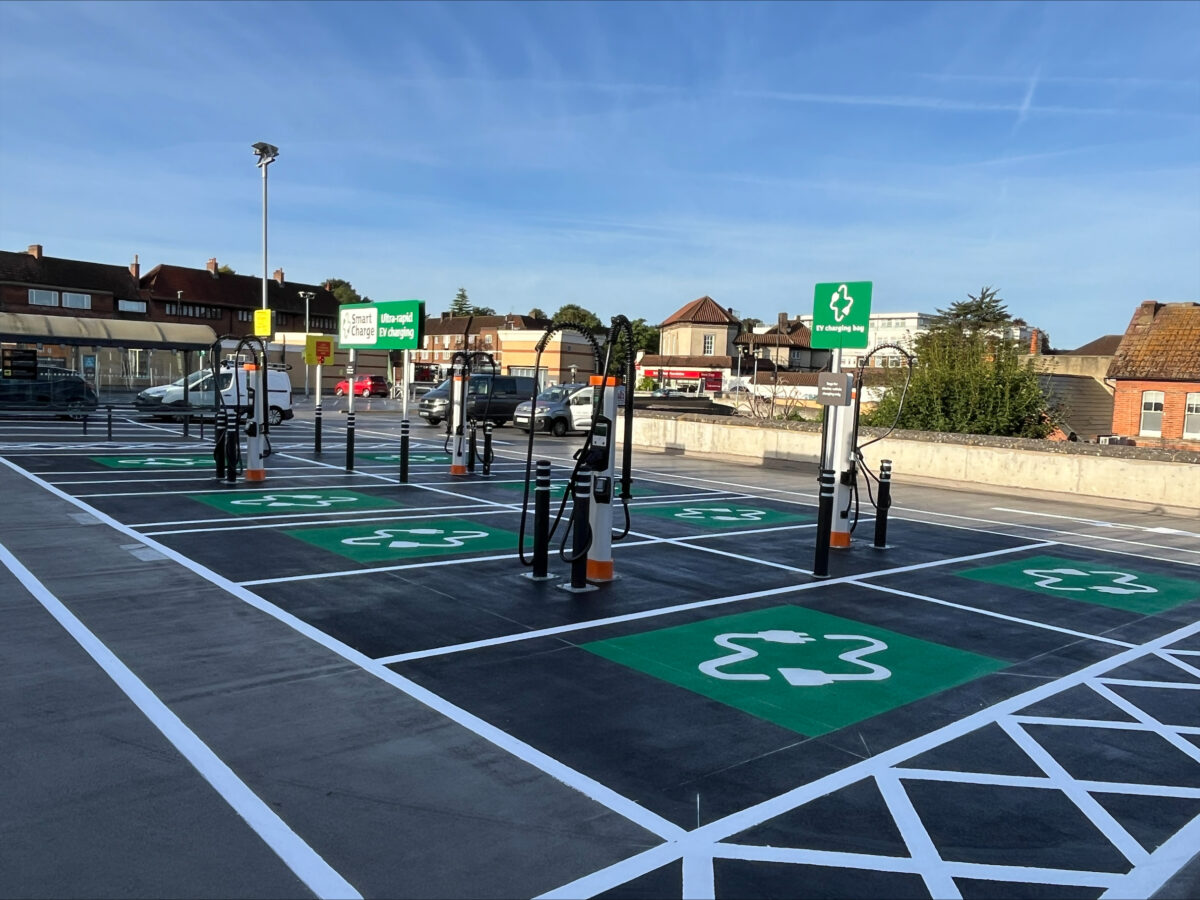
Is there a universal EV charging bay symbol?
Despite a plea from operators and the public, there isn’t a universal charging bay symbol. In fact, it’s a largely unregulated area, much to the...
Read more

What is anti-skid surfacing?
If you’ve ever driven in heavy weather conditions and found it surprisingly grippy when slowing down, you’ve driven over anti-skid surfacing. Sometimes referred to as...
Read more

Playground markings: What are the rules?
School playground markings are one of the most effective ways to get children active during break time. Hopscotch grids, number trails, or noughts and crosses...
Read more
Would you like to work with us?
Got a query? Need a quote? Call or message us via the website, and we’ll get back to you with an answer. Our team is here to help. We could talk about road marking for hours (but we know you’d prefer we didn’t, so we’ll try to keep it short).