
Despite a plea from operators and the public, there isn’t a universal charging bay symbol. In fact, it’s a largely unregulated area, much to the chagrin of industry bodies, who believe more signs would reassure reluctant EV owners that plenty of charging stations exist; they’re just not well signposted.
The lack of regulation makes it harder for drivers to find the nearest charging station, and challenging for the contractors tasked with marking out EV bays in the first place. It’s a bit like the Wild West out there with little to no standardisation, but there are at least some best practices, which we cover below.
Why does EV signage matter anyway?
Clear signage matters for EV drivers as much as it does for operators investing in expanding Britain’s car-charging network.
Wayfinding signage on major roads and motorways helps drivers find their nearest charging stations. Having that visible reassurance that you’re near a charging point provides drivers with comfort when the inevitable range anxiety kicks in.
Crucially, signage helps operators maximise bay occupancy in return for the thousands they’ve invested in EV charging points.
Once in the car park or service station, directional arrows help drivers find the charging points, especially if they’re hidden at the back or on a lower level of a multi-story car park.
Floor graphics that clearly mark EV spaces as separate from regular parking bays help to prevent “ICE-ing” (petrol/diesel vehicles parking in EV charging spots), which unnecessarily blocks bays.
Finally, eye-level signage in each bay with clearly explained parking rules is the only way to legally enforce who can park there and the time limits on how long electric vehicles can stay there while charging.
EV bay sign vs road marking
It’s important here to distinguish between EV bay signs and floor markings.
There are some guidelines on what you should include on signs at the point of charging. Mandatory items include pricing and the socket type and voltage (usually indicated by a letter inside a hexagon).
Additionally, if you want to enforce penalty charge notices and fines for misuse of the space, then your signage must make the rules clear. This includes stating that only electric vehicles can park there while charging, along with a time limit.
Conversely, charger space floor graphics aren’t subject to any regulations. They can be tailored to fit the car park owner’s preferred style or branding.
Common types of EV bay floor graphics
Over the years, we’ve gathered ideas from marking out hundreds of car parks, which we share with our customers to inspire their own designs.


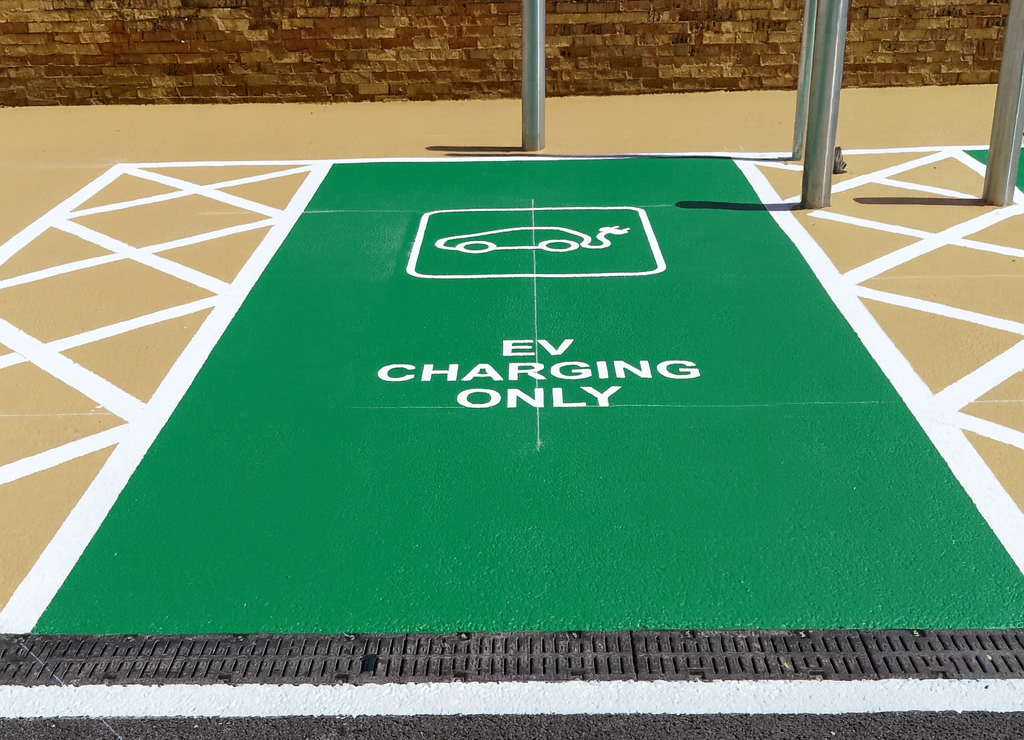


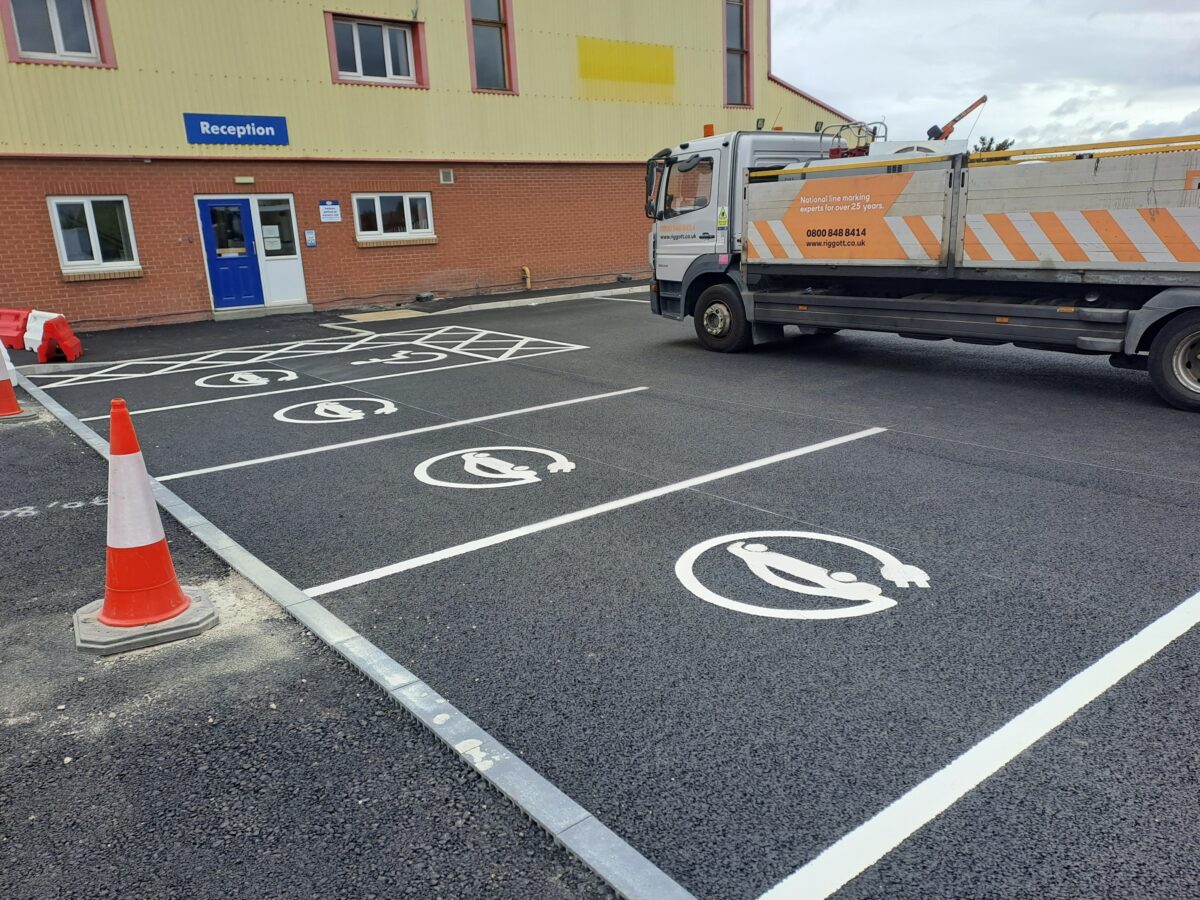
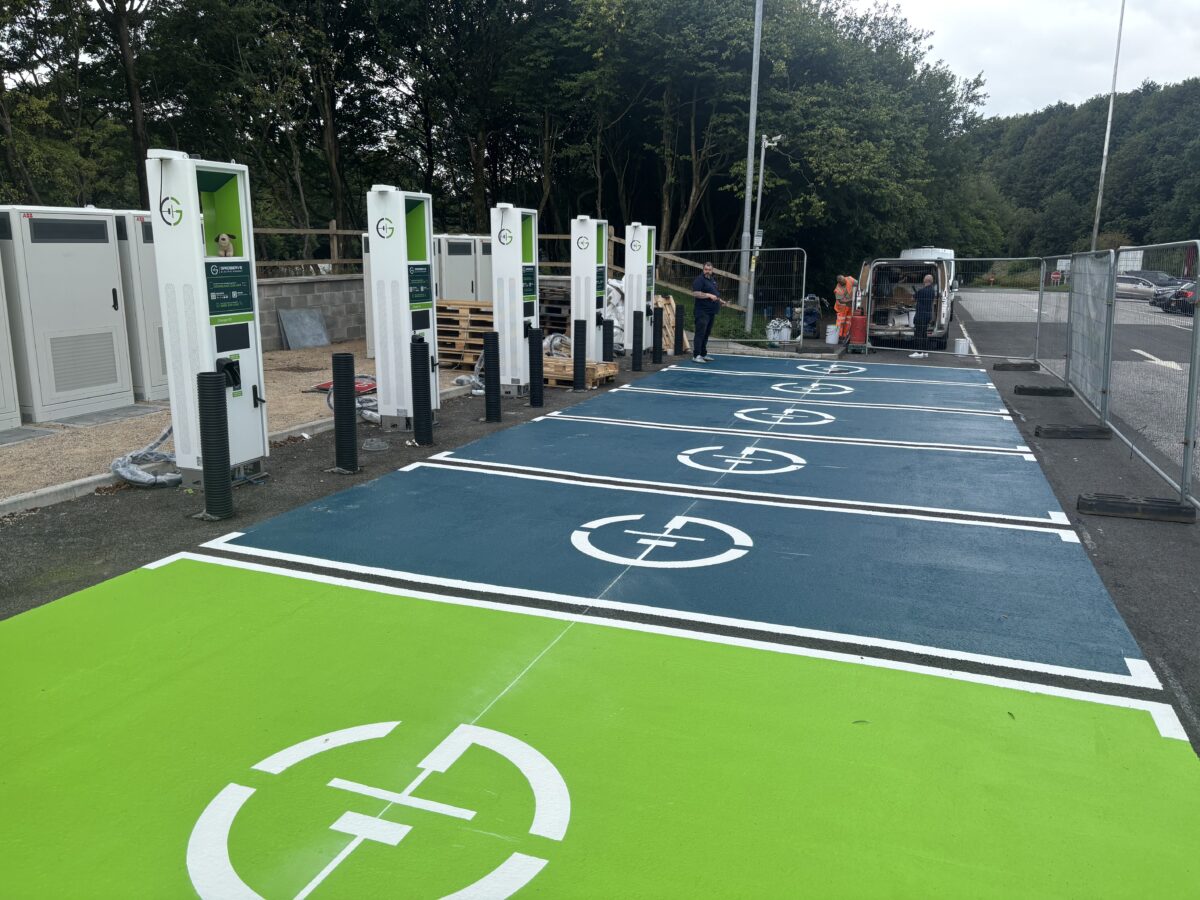
The most common types of EV floor graphics include:
1. Car with a charging plug or cable
A clear, recognisable pictogram; this is one of the most widely used plug-in car parking logos. In a UK government study, this symbol was found to be one of the most instantly recognisable and universally understood.
2. Plug or charging-point symbol
This simple plug and socket icon is often paired with a lightning bolt to infer an electric charging point. It’s widely thought to be an easily recognisable symbol for EV charging.
3. EV lettering with a lightning bolt
“EV” or “EV CHARGING” lettering is a minimalist option that can be paired with a lightning bolt for added clarification and universality. This is a popular choice with charging point providers.
Variations of these charge point parking icons exist up and down the UK. Some choose to style their floor graphics in keeping with their brand while others simply prefer to put their own twist on the design.
What colour are EV charging bays in the UK?
Because EV bay floor graphics can be any style, there are many variations, but they typically have a green background contrasted with a sharp white EV charging bay symbol stencilled over the top.
Green is closely associated with the environment, renewables, and cleaner energy. What’s more, it stands out. It’s more likely to be noticed in a cluttered concrete landscape, helping drivers find the right spot when they pull into a crowded car park.
EV bays must be clearly marked to distinguish them from other spaces and avoid confusion. Painting bays in bright blocks of colour, like green, makes it obvious this is not a normal car parking space.
Any confusion can lead to blocked bays, frustrating EV owners looking for a place to charge and costing the operator in lost revenue.
EV bay stencil vs preformed thermoplastic
Car parking floor graphics are typically applied either with paint and a stencil or preformed thermoplastic. Each method has pros and cons, and the right approach usually depends on the job.
Stencil and paint is a lower-cost option suitable for a small number of bays. You can choose the wording, colour, and design. Paint is also easy to refresh or completely change when required.
The finish and legibility of stencilled markings depend on careful surface preparation and application. Choosing an experienced EV marking contractor is essential for the most precise and legible floor graphics.
Factory-cut preformed graphics are a good choice for large car parks, as they help ensure consistent markings across many bays. With correct surface preparation and professional installation, their vibrant colours will stand up to the wear and tear of heavy traffic.
Overall, heat-applied thermoplastics typically offer better wear resistance and have a longer life than ordinary paint, providing better long-term value.
As with stencil and paint, the performance of preformed graphics depends on correct surface preparation for optimum adhesion. Applying graphics either with paint or thermoplastics to an unstable substrate will ultimately mean they’ll need reapplying sooner than you might like.
Differences across Europe
As you drive across Europe, the differences in EV signage and car park floor graphics are stark. The UK is the most advanced in its approach to standardising signage, but there are plenty of gaps still to plug.
The only consistency you’ll find across the continent is the mandatory plug type and voltage, which must be displayed on or near the charging point. This should match the one found on the flap of the electric vehicle socket.
When you consider the universality of the disabled parking icon, or even the parent-and-child spaces, it seems obvious that EV signage and floor graphics in car parks should follow a similar approach.
Until regulations change, it’s up to charging point providers, signage firms, and car park marking contractors to ensure EV symbols are striking enough to be noticed and literal enough to be understood.


