

Level Crossing Markings
Precise level-crossing markings are critical to ensuring that drivers stop at a safe distance from the tracks. Our high-visibility rail-accredited surfacing materials are formulated to adhere to rubber-based level crossings without the flaking, peeling, or fading associated with low-grade products.
Riggott’s expert line-marking application, combined with superior surfacing products from fellow-Tennants Group company Kestrel, guarantees high-quality reflective markings that keep the nation’s level crossings safe.
RISQS-accredited railway markings
Britain’s railway sector is highly regulated for the protection of rail users and staff. Suppliers must demonstrate compliance with the highest safety standards before they can tender work on any of the 6,000 level crossings in England, Wales, and Scotland.
Our level crossing road markings are RISQS-accredited, compliant with the European road marking standard EN 1436, and adhere to the Road Safety Principles and Guidance (RSPG) set by the Office for Rail and Road.
Additionally, we have the correct approval from Network Rail to work on the rail infrastructure in Great Britain.

RISQS-Accredited
RISQS is the official supplier qualification scheme to the railway sector. Accredited suppliers are independently verified to ensure they meet high safety standards.
EN 1436 Standards
EN 1436 is a European standard that specifies requirements for the performance, durability and visibility of road marking materials.
Rail Safety Guidelines
The Railway Safety Principles and Guidance (RSPG) is a set of guidelines that includes a section on the design and operation of level crossings to ensure their safe use.
Multipolymer level crossing road markings
We use a multipolymer surface coating in a range of colours and widths designed to adhere to railway crossing substrates, such as rubber and steel. A primer is applied in advance to improve the adhesion, weather resistance, and overall durability of the top coat. Combined, they create a skid-resistant, reflective solution for level crossing markings.
Retroreflectivity is a key component of our materials, enabling road paint markings to reflect vehicle headlights with minimal scattering. High visibility in low light or adverse weather reduces the risk of accidents and improves road safety.
Designed to dry quickly, we get the job done with minimal disruption to rail passengers while maintaining the high safety standards expected while working on a railway line. Our safety accreditations are a reflection of the work that goes on behind the scenes to make Riggotts one of the UK’s premier line marking companies.

A Tennant’s Group collaboration
Bringing together Riggott’s expertise in road and line marking with Kestral’s high-grade surface materials, we are proud to offer RISQS-accredited level crossing markings across the nation.
Both valued members of the Tennant’s Group, we can leverage our partnership with Kestrel to deliver the highest-quality solutions to our customers. This not only enhances our service but also guarantees that our clients benefit from the combined strengths of both companies, setting new standards in safety and durability for level crossing markings.

Vital Car Park Line Marking in Derby
Our specialist paint teams have recently completed a comprehensive line marking project for a newly constructed multi-storey car park at a busy NHS hospital, including the installation of parking bay lines, walkway tram lines, logos and wayfinding markings. In order to meet the escalating need for NHS services, the surface level car park was replaced…
Read more

Case Study
Successfully Crossing the Finish Line in Aylesford
Our dedicated line marking teams have recently completed a large scale project for a well known retailer, comprising installation of new markings to warehouse areas and external service yard and car parks. Aylesford Distribution Centre is a 621,000 sq. ft facility in Kent – equivalent to 295 tennis courts! This large warehouse facility also includes…
Read more

Case Study
Precision Line Marking at Luton Airport
Riggott & Co Ltd have successfully handed over the line marking scheme as part of Luton Airport’s multi-storey car park reconstruction. Luton Airport is the UK’s fifth busiest airport, with anywhere from 150 to 300 flights taking off each day. In 2024, Luton Airport served an impressive 16.7 million passengers! It is home to some…
Read more

Case Study
New Anti-Slip Coating for Swindon Car Park
Our night crew have been busy creating a safer environment for car park users at Orbital Shopping Park in Swindon. Returning client British Land entrusted Riggotts to deliver this vital installation within their programme and budget. Over a week, our specialists masked and rolled over 1500m2 of colourful fast-curing MMA (Methyl Methacrylate) to clearly delineate…
Read more

Case Study
New Road Markings and Infrastructure Improvements to the A47
Now that the country has almost fully reopened after an arduous lockdown, we now see the start of a Great British summer. However, as going on holiday abroad isn’t looking too feasible and temperatures reaching record highs in the UK, the general public are heading to England’s coasts by the masses to reconnect with that…
Read more

Case Study
New Electric Vehicle Charging Bays for Baldock Services
After recent petitions, TV programmes and growing public concern for the environment, there has been a sharp rise in electric vehicle sales throughout the UK. With nearly 260,000 pure electric cars on UK roads at the end of May 2021 and more than 535,000 plug-in models, including plug-in hybrids (PHEVs). The demand for electric vehicle…
Read more

Case Study
Dynamic Line Marking for Builders Merchant Branch in Norfolk
In our line of work, different surfaces present different problems and solutions. For example, asphalt can presents difficulties with paint and concrete with thermoplastic. However, that’s why we use methods to ensure complete adhesion no matter the surface or material. A national builders merchant asked us to complete works at one of their branches in…
Read more

Case Study
Refreshing the sports court line markings for Barnstable School
Now that schools are once again open, playgrounds and sports courts are filled with kids having fun – whether it be sports or just plain old tag, it’s only right, we refresh the sports court line markings to a standard no referee will question. Riggotts carried out lining for a long-overdue sports court, and car…
Read more

Case Study
Anti-Skid Surfacing for Newport Pagnell Client
As the April showers continue into May, we’ve seen an abundance of rainfall mixed with sunny spells when the weather allows it. Recently, Riggotts carried out hot-applied anti-skid surfacing to a bus stop in Newport Pagnell. There are many advantages to anti-skid surfacing; it creates a safe working environment for employees when applied in the…
Read more

Case Study
Barnsley Ford Forecourt Line Marking
With the UK looking towards the hopeful end of this arduous pandemic, and the further lifting of lockdown rules, people are finally able to leave the house and venture out towards the long-awaited return of non-essential shops – which includes car dealerships/forecourts. One thing we’ve learnt about this pandemic is that appearances when looking online…
Read more

Case Study
Recent news and stories from Riggotts
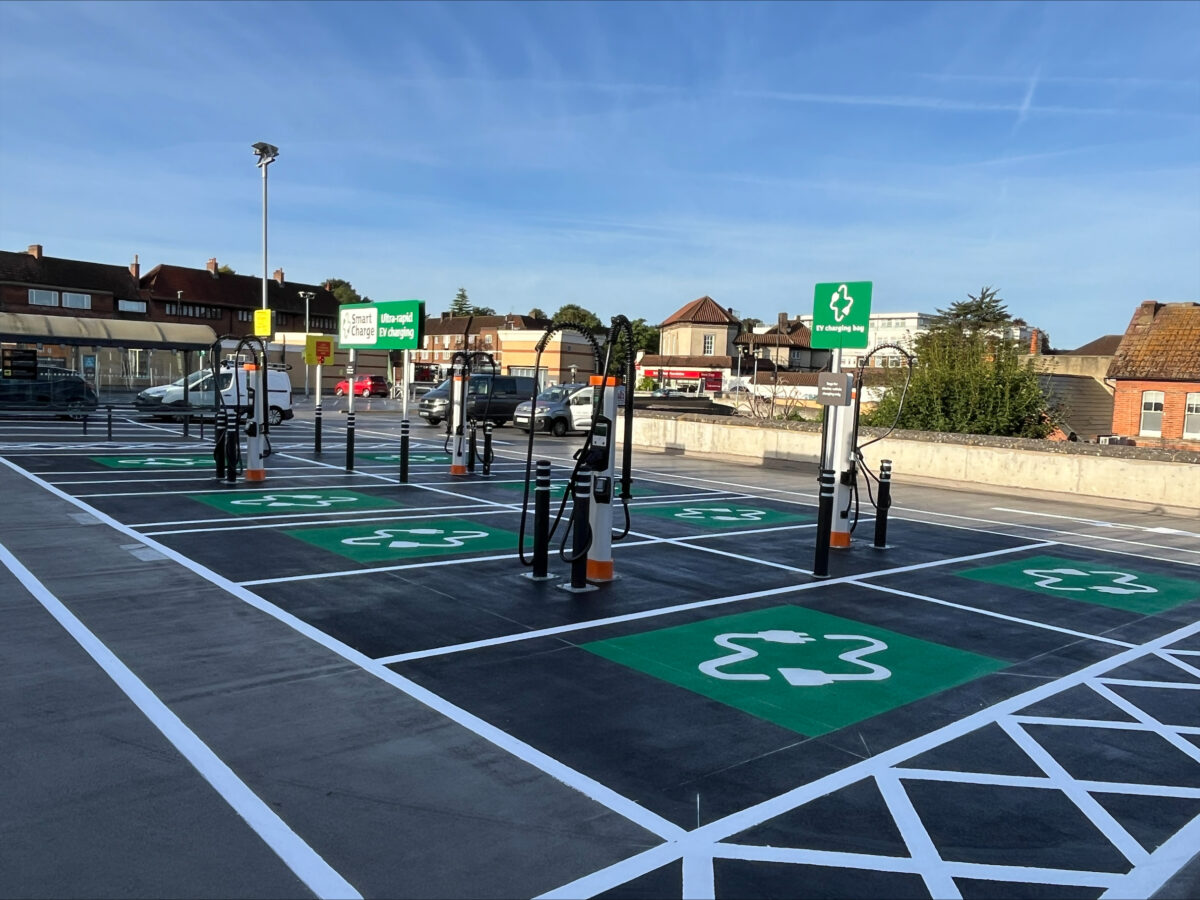
Is there a universal EV charging bay symbol?
Despite a plea from operators and the public, there isn’t a universal charging bay symbol. In fact, it’s a largely unregulated area, much to the...
Read more

What is anti-skid surfacing?
If you’ve ever driven in heavy weather conditions and found it surprisingly grippy when slowing down, you’ve driven over anti-skid surfacing. Sometimes referred to as...
Read more

Playground markings: What are the rules?
School playground markings are one of the most effective ways to get children active during break time. Hopscotch grids, number trails, or noughts and crosses...
Read more
Would you like to work with us?
Got a query? Need a quote? Call or message us via the website, and we’ll get back to you with an answer. Our team is here to help. We could talk about road marking for hours (but we know you’d prefer we didn’t, so we’ll try to keep it short).